
AI has made it ridiculously easy to build something on the internet. You can turn an idea into a website, an app, or a working product in a weekend. That's exciting. But there's a problem nobody talks about enough: building the thing is no longer the hardest part. Getting anyone to see it is.
Everybody can build. Who gets the traffic?
Look around. Every day there's another AI-built startup, another SaaS tool, another directory, another app. People are paying for AI subscriptions, hosting, domains, APIs, email services, and development tools. Then they launch and discover that having a product doesn't mean having an audience.
The companies selling the shovels get paid whether your project finds customers or not. That doesn't mean nobody else makes money. Plenty of independent businesses do. But the incentives are hard to ignore.
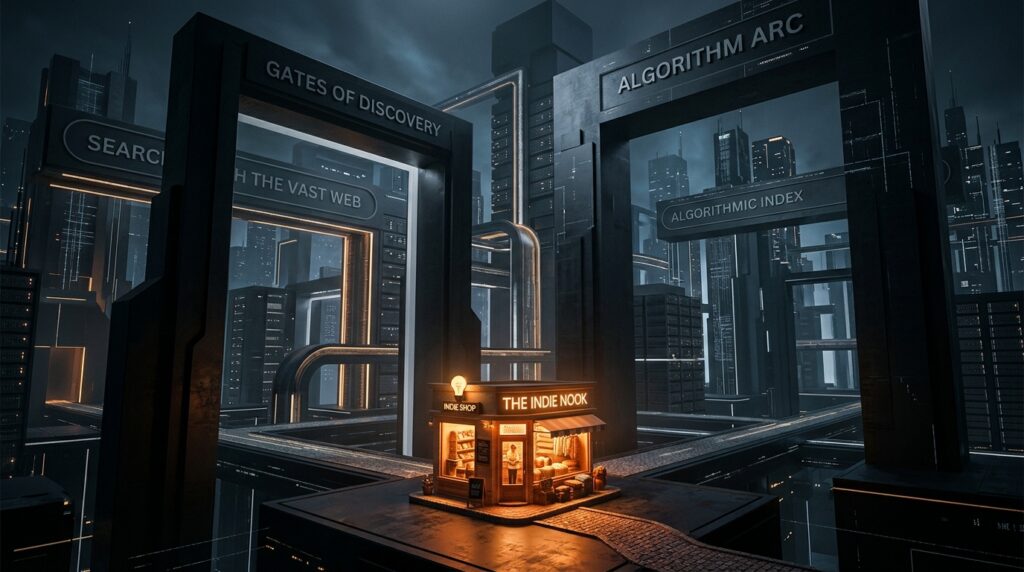
The gatekeepers of the internet
Google and Microsoft influence what people find in search. OpenAI, Anthropic, Google, Perplexity, and xAI are shaping how people get answers, often without visiting the websites behind the information. Meta, X, TikTok, Reddit, and LinkedIn decide how far posts travel. Apple and Google control major app distribution channels. Amazon, Microsoft, Google, and Cloudflare provide infrastructure much of the web depends on. Stripe and PayPal handle payments for countless online businesses.
These companies do different jobs, and most provide genuinely useful services. But together they show how many outside decisions can affect a business you supposedly own.
Search is changing, and publishers feel it
For years, the deal was simple: websites published useful information, search engines indexed it, and search results sent visitors back to those sites. Now AI-generated summaries can answer a question right on the results page. That is convenient for the person searching, but what happens to the website that researched and published the answer?
In a 2025 study, Pew Research Center found that users clicked a traditional search result in 8% of visits with a Google AI summary, compared with 15% of visits without one. That's a meaningful difference, though it doesn't prove every website loses the same amount of traffic. Read the Pew research.
It's not just about AI, either. You can spend months growing an audience on a social platform and see your reach disappear after a policy change, an account restriction, or an algorithm update. You can build a great app and still depend on a store's approval process. You can own a domain and still rent almost every route people take to reach it.
We have more building tools than ever, but discovery is getting harder
Here's the irony. AI lowers the barrier to creating a business, so more people create businesses. That means even more products competing for the same attention. The ability to build becomes common. Real attention becomes scarce.
And when organic reach is uncertain, what's the usual advice? Buy ads. Pay for promotion. Subscribe to another tool. Spend more money just to get a chance to be seen.
I'm not against AI. I use it. I'm not against search engines or social media either. But I don't think the future of the internet should be a handful of companies deciding which independent projects deserve an audience.
Maybe discovery needs to be more human again
Remember when finding a new website felt like exploring? Someone shared a link, you clicked it, and you found something you didn't even know you were looking for. No one needed to turn every discovery into an ad campaign.
That's part of why I'm building NexURLs. It's a place to share URLs, find interesting projects, and let people discover things through other people. Not everything needs to be optimized for an algorithm. Sometimes a good link should just get a chance to be seen.
AI solved a lot of the problem of building something. It didn't solve the problem of getting anyone to see it.
And until we talk more about who controls discovery, we'll keep celebrating how easy it is to launch while ignoring how hard it is to survive.
Featured on NexURLs
Sites from NexURLs that go with this post.
 Stratecherystratechery.comIn-depth analysis of how big tech shapes discovery, strategy, and the business of technology.
 GitHub Trendinggithub.comSee which open-source and indie projects are gaining attention among developers today.
 HuggingChat: Open-source ChatGPT alternative with web searchhuggingface.coAn open-source chat interface that demonstrates alternatives to closed AI answer providers.